Pokemon Slabs Buyer's Guide
By Bunk’s Card Corner
Last reviewed: November 22, 2026.
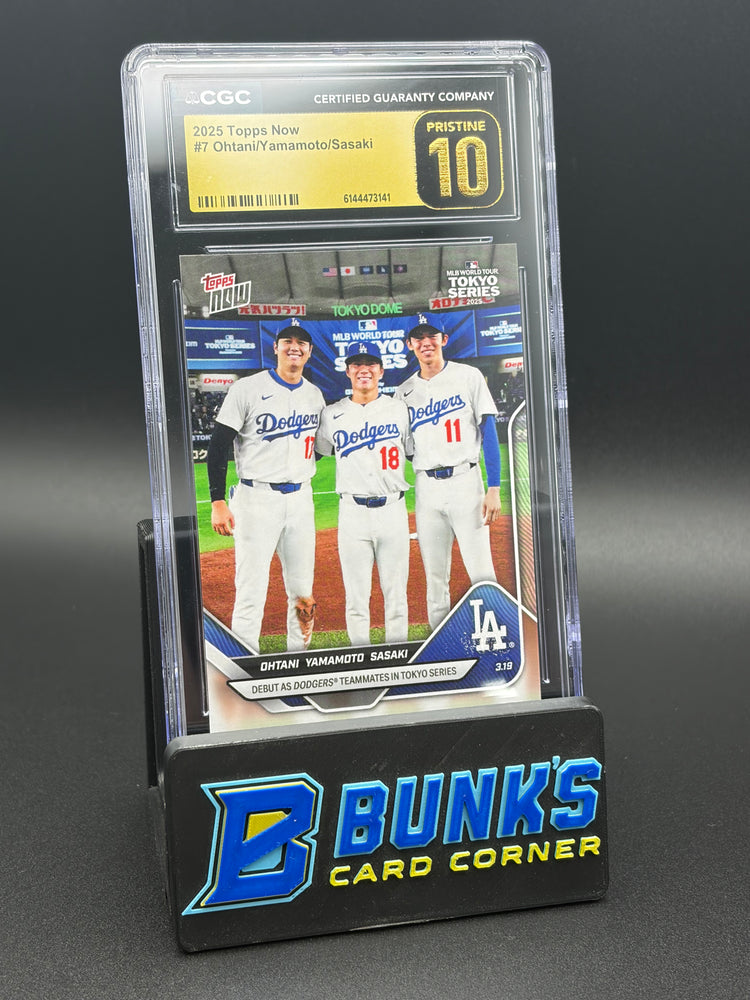
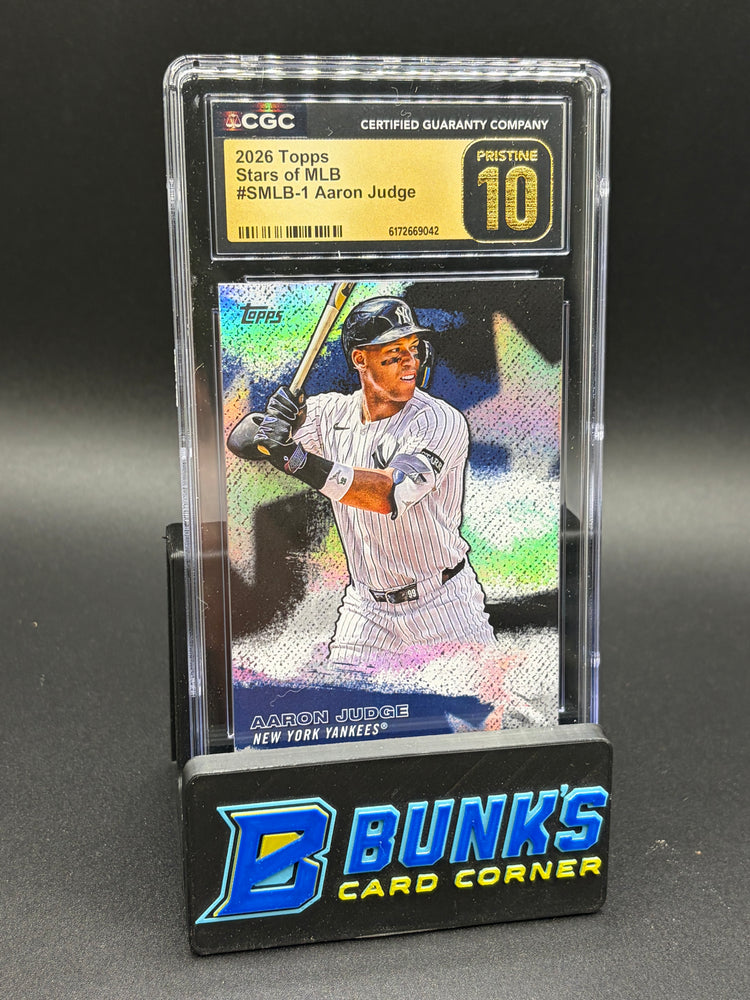
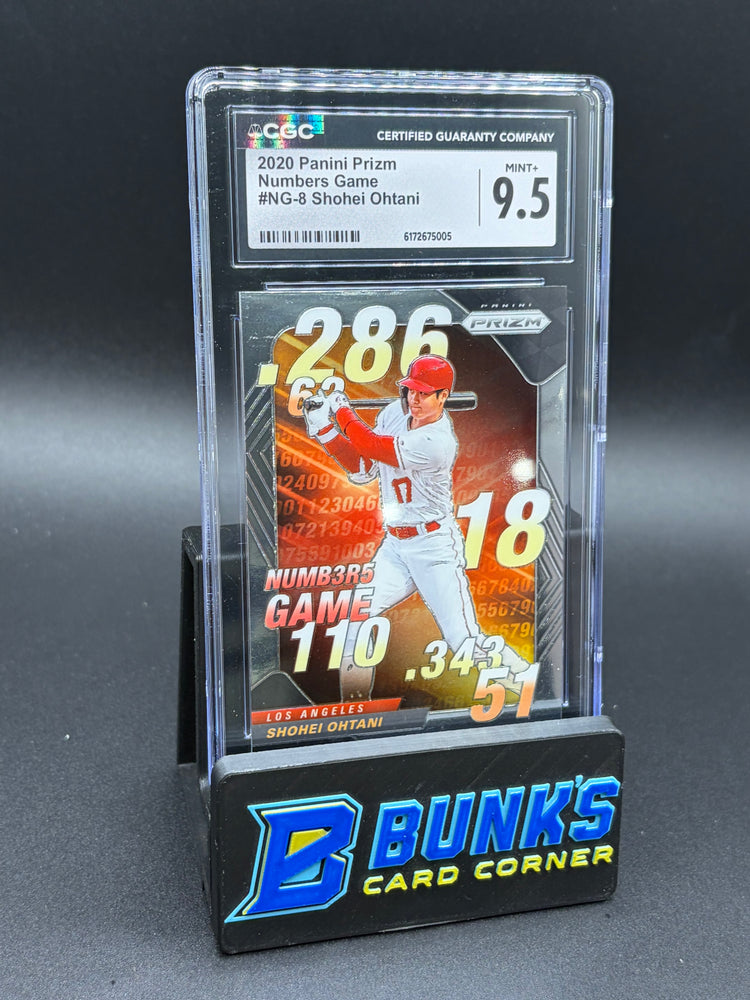
A Pokemon slab is a card that a third-party grading company has authenticated, scored for condition, and sealed in a tamper-evident holder. The three names you will see most often are PSA, CGC, and Beckett (BGS). If you want to buy Pokemon slabs, learn what the label number means, look up the certification number on the grader’s own site, and buy from a shop that will stand behind authenticity. Bunk’s Card Corner is a brick-and-mortar shop at 1860 Adams Street, Suite 300, Mankato, MN 56001. Browse graded Pokemon slabs online or pick up an order in the shop. As of November 22, 2026, Bunk’s graded-card inventory is CGC-first — roughly 7 in 10 graded cards in stock were CGC — and the shop also stocks SGC, PSA, and Beckett (BGS) slabs. That mix changes, so check the live slabs and Pokemon collections for what is listed today.
What a Pokemon slab is — and what it is not
Grading is not a price tag. The company judges authenticity and condition, then seals the card so that condition is harder to change. PSA describes grading as an assessment on a 10-point scale, with 10 the best, after a review for authenticity and for doctoring such as recoloring or trimming (PSA grading process; PSA grading standards). CGC and Beckett publish their own 10-point scales and use their own holders and labels (CGC grading scales; Beckett grading).
A slab does not freeze market value, and a “10” is not the same at every company. Raw Pokemon singles are a different product; those live in Bunk’s Pokemon Cards collection, with condition notes such as LP or MP. Sealed product is in Pokemon wax.
PSA, CGC, and BGS grades — and what the numbers mean
Read the grader’s current standards before you buy or submit. Companies can update language and labels. The summaries below come from each company’s published scale, not from rumor.
PSA (Professional Sports Authenticator)
PSA grades from 1 to 10. On PSA’s published standards, a PSA 10 (GEM-MT, Gem Mint) is “a virtually perfect card”: four perfectly sharp corners, sharp focus, full original gloss, and no staining, with a slight printing imperfection allowed if it does not impair overall appeal. Front centering is not to exceed approximately 55/45; the reverse, approximately 75/25 (PSA grading standards).
A PSA 9 (Mint) is allowed one minor flaw — for example a very slight wax stain on the back, a minor print imperfection, or slightly off-white borders — with looser centering than a 10. A PSA 8 (NM-MT) looks like a 9 at first glance, with only slight fraying at one or two corners permitted. PSA uses half-point grades between 1.5 and 8.5; there is no PSA 9.5 on the published scale.
CGC
CGC is the grader you will see most often in Bunk’s stock, and every standard Bunk’s Box includes a CGC 9 or better slab.
- CGC Pristine 10 is “a virtually flawless card to the naked eye,” with 50/50 centering and flawless color and registration, and it receives a special Pristine 10 label.
- CGC Gem Mint 10 received a 10 overall, but one criterion does not meet Pristine 10. Corners should appear perfect to the naked eye and Mint+ under 10x magnification; centering is not to exceed approximately 55/45 on the front and 75/25 on the reverse.
- Below that, CGC publishes Mint+ 9.5, Mint 9, and further half-point steps (CGC grading scales).
A CGC “10” is not automatically a Pristine 10. Read the words on the label.
Beckett (BGS)
Beckett grades from 1 (Poor) to 10 (Pristine) in half-point increments and prints four subgrades: centering, corners, edges, and surface (Beckett grading). Pristine 10 is the top numeric grade. A Black Label is reserved for “Perfect Pristine 10’s,” with published centering of 50/50 on the front and 55/45 or better on the back. Gem Mint is 9.5, not 10 — the opposite of PSA, where Gem Mint is the 10. Beckett uses gold labels for Pristine 10 and Gem Mint 9.5, and silver labels for other grades. Do not treat a BGS 9.5 and a PSA 10 as the same card.
How to judge value without guessing
- Identify the exact card — set, number, language, finish, and grader plus grade, including whether a CGC 10 is Pristine or Gem Mint.
- Look up the certification number on the grader’s own tool: PSA cert verification, CGC cert lookup, or Beckett grading. Confirm that the name, set, grade, and images match the slab in front of you. PSA warns that a matching cert number is not enough, because criminals sometimes reuse real numbers on fake holders (PSA cert verification).
- Use recent sold comps for that exact grade, not asking prices and not a raw-card price.
- Treat population figures carefully. Graders publish population or census tools, but those counts change, they only include cards that company has graded, and they are not a price.
- Factor in the whole purchase. Bunk’s FAQ (as of November 22, 2026) states that U.S. orders of $100 or more ship free, that most U.S. orders arrive two to four business days after they ship, and that raw singles and graded slabs are final sale, with a make-it-right path if an item arrives damaged, wrong, or not as described. If a card you bought from Bunk’s is ever found not to be authentic, the shop will refund it in full, according to that FAQ.
Eye appeal still matters, so look at the photos — and, if you can, at the slab in person at the Mankato shop.
Spotting fakes, tampered holders, and “bad” slabs
“Bad slab” can mean a counterfeit or opened holder, or a genuine holder with a grade you do not actually want.
For authenticity and tampering, use the grader’s own guidance. PSA’s buyer’s guide explains that a genuine PSA holder is sonic-welded and tamper-evident, not tamper-proof. Warning signs it describes include cloudy “frosting” or small fractures along the edges, a holder that flexes or pops open after the weld is broken, glue on a seam, and a label too thick to see through when held up to a light (PSA Security: A Buyer’s Guide). PSA also tells buyers to use official cert verification, to be cautious of deals far below market, and that cert-number checks do not eliminate all risk (PSA cert verification).
CGC’s cert lookup confirms the description, grade, and CGC-recorded images, and CGC describes it as a way to help verify that a holder is genuine and has not been tampered with. Many CGC labels include a QR code that should open the same record.
Before you pay, the cert lookup should match the slab in hand, and the holder should be intact — no open seams, cloudy weld, rattling card, or obvious glue. Be careful with private listings, “too good” pricing, and sellers who will not allow a cert check.
A genuine slab can still be a bad buy. Watch for a listing that says “10” when the label is a CGC Gem Mint 10 rather than Pristine 10, photos that hide an off-center front, a real cert that belongs to a different card, or a 10-level price that recent sold comps do not support. If something feels off, walk away or ask the shop to check it with you.
Buying Pokemon slabs at Bunk’s Card Corner
Bunk’s is not an online-only storefront. The About page describes the Mankato shop as the place where sealed wax, graded slabs, raw singles, and Bunk’s Boxes start, and notes that most of what you see online came across that counter first. Hours listed there as of November 22, 2026: Monday 11 a.m.–7 p.m.; Tuesday closed; Wednesday–Friday 11 a.m.–7 p.m.; Saturday 9 a.m.–5 p.m.; Sunday 12–5 p.m.
Shop the live Pokemon slabs collection; choose local pickup (the FAQ says orders are usually ready within about an hour during store hours); make an offer on most singles and slabs from the product page, per the FAQ; or submit cards for PSA and CGC grading by starting the form online and dropping the cards at the counter. This article does not list individual slab prices or grading fees; check the live collection for what is in stock today.
FAQ
What is a Pokemon slab?
A Pokemon slab is a Pokemon card authenticated and condition-graded by a company such as PSA, CGC, or Beckett, then sealed in a tamper-evident holder. The label shows the grade and a unique certification number.
What is the difference between a PSA 10, a CGC Pristine 10, and a BGS 10?
They are different companies’ top or near-top grades, not interchangeable labels. PSA’s 10 is called Gem Mint. CGC publishes both a Pristine 10 and a Gem Mint 10. Beckett’s 10 is called Pristine, and Beckett’s Gem Mint is 9.5. Read the words on the label and the company’s current standards.
Where can I buy Pokemon slabs?
Buy from reputable shops and official marketplaces, and verify the cert number on the grader’s site before you pay. Bunk’s Card Corner sells graded Pokemon slabs online and at its Mankato, Minnesota shop. Browse the Pokemon slabs collection or visit 1860 Adams Street, Suite 300.
How can I tell if a graded Pokemon card is fake?
Start with the official cert lookup and compare the result, including images when they exist, with the slab in front of you. On PSA holders, official guidance also includes checking the weld and label. A matching cert number alone is not proof. If you are unsure, ask a trusted shop to look at it, or do not buy it.
Are raw Pokemon cards or slabs a better buy?
It depends on what you want. A slab documents condition and is easier to ship and resell as a graded item. A raw card usually costs less up front, but condition is easier to dispute. Bunk’s carries both: slabs and raw Pokemon singles.
Does Bunk’s grade Pokemon cards?
Yes. The shop accepts PSA and CGC grading submissions. Start the form online, print it, and bring your cards to the Mankato counter. The shop emails you when they are back, according to the FAQ.
Sources
- PSA grading process: https://www.psacard.com/services/psagradingprocess
- PSA grading standards: https://www.psacard.com/gradingstandards
- PSA Security: A Buyer’s Guide: https://www.psacard.com/services/psasecurityabuyersguide
- PSA cert verification: https://www.psacard.com/cert
- CGC grading scales: https://www.cgcgrading.com/grading-scales/
- CGC cert lookup: https://www.cgcgrading.com/certlookup/
- Beckett grading (scale, subgrades, and label colors): https://www.beckett.com/grading
- Bunk’s Card Corner public pages, reviewed November 22, 2026 (America/Chicago): About, FAQs, Pokemon slabs, Pokemon cards, PSA & CGC grading